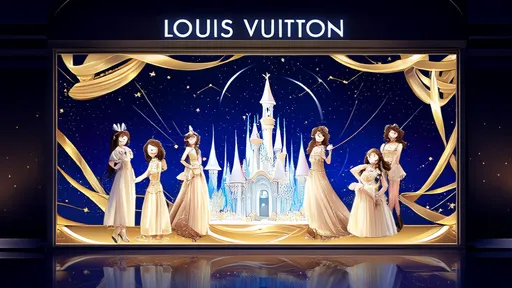
In the ever-evolving landscape of luxury fashion, few brands command the narrative power of LOUIS VUITTON. Their latest visual spectacle—a whimsical Fairy Tale Universe displayed through their store windows—has become a masterclass in window narratology, transforming commercial spaces into portals of fantasy. This isn't mere merchandising; it's a carefully orchestrated dialogue between brand mythology and consumer imagination, where every mannequin, prop, and lighting choice whispers secrets of a parallel world.
The Fairy Tale Universe theme draws from archetypal stories—talking animals, enchanted forests, and objects with souls—but subverts them through LV's signature irreverence. A monogrammed pumpkin carriage sits beside a trunk sprouting golden vines, while leather-clad wolves eye Damier checkered capes. The windows don't just reference fairy tales; they rewrite them with the codes of contemporary luxury. What emerges is a neo-gothic wonderland where heritage leather goods become magical artifacts, and shopping bags double as treasure chests.
Lighting plays a crucial role in this narrative. Unlike the clinical brightness typical of luxury stores, LV employs dappled shadows and prismatic reflections, mimicking sunlight filtering through enchanted woods. Spotlights highlight key pieces like Excalibur-esque handbags, while darker corners conceal "easter eggs"—perhaps a miniature dragon coiled around a perfume bottle. This chiaroscuro effect creates movement within static displays, inviting viewers to mentally step into the scene.
Material alchemy further deepens the storytelling. Traditional display materials like chrome and acrylic are replaced with tactile wonders: velvet mushrooms that seem to breathe, "growing" from suitcase displays; "glass" slippers crafted from actual crystal-hardened leather. The most striking alchemy lies in the animated mannequins—not through technology, but through their postures. One leans forward as if whispering to a bird-shaped clutch, another mid-stride with a trailing scarf suggesting sudden flight. These frozen moments imply an ongoing story beyond the glass.
Cultural theorists might argue LV's windows deconstruct fairy tale tropes to reflect modern values. The traditional "damsel in distress" is absent; instead, mannequins exude agency—a queen placing a crown upon her own head, a traveler (gender ambiguous) conquering a mountain of trunks. Even the "villains" are stylish, their menace conveyed through python boots rather than claws. This recalibration makes the fantasy accessible to today's audience while preserving the tales' archetypal power.
The soundscape, audible to those pressing close, completes the immersion. Rather than looping music, each window emits distinct audio textures: rustling pages near book-shaped clutches, distant hoofbeats by riding boots, a chorus of chimes when someone approaches. This sonic layering rewards prolonged engagement, turning casual shoppers into active participants in the narrative.
Critically, the windows avoid literal storytelling. There are no placards explaining scenes or product placements breaking the spell. A unicorn might "hold" a purse in its mouth, but the item feels organically part of its world—not a sales tactic. This restraint maintains the mystique central to both fairy tales and luxury branding. The lack of explanation creates desire through curiosity, not instruction.
Seasoned window designers note how LV plays with scale to disorient and delight. Oversized keychains dangle like dungeon relics, while a "giant's closet" display makes regular bags seem doll-sized. This manipulation of perspective echoes Alice's adventures, physically drawing viewers closer (and into buying range) while symbolically suggesting LV products are keys to transformative experiences.
The Fairy Tale Universe succeeds because it balances nostalgia with novelty. Familiar story elements provide comfort, while surreal twists—a mouse wearing sunglasses, a castle made of stacked watches—keep the mind engaged. It's a reminder that luxury today isn't about perfection, but about permission to wonder. In an age of digital overload, these windows offer something increasingly rare: the tactile, slow-burn pleasure of a story unfolding in real space.
Ultimately, LV's windows transcend their commercial purpose. They become cultural artifacts, sparking conversations about how we consume stories and luxury alike. As pedestrians pause to photograph not just products but entire scenes, the brand achieves something remarkable: their windows don't display merchandise—they eclipse it, making the act of looking feel like the first page of a personal adventure.
By /Aug 13, 2025

By /Aug 13, 2025
By /Aug 13, 2025
By /Aug 13, 2025
By /Aug 13, 2025
By /Aug 13, 2025

By /Aug 13, 2025
By /Aug 13, 2025
By /Aug 13, 2025
By /Aug 13, 2025
By /Aug 13, 2025
By /Aug 13, 2025
By /Aug 13, 2025
By /Aug 13, 2025

By /Aug 13, 2025
By /Aug 13, 2025
By /Aug 13, 2025
By /Aug 13, 2025
By /Aug 13, 2025
By /Aug 13, 2025
