The world of live streaming is undergoing a seismic shift, and at the heart of this transformation lies the convergence of multi-camera production and virtual reality (VR) technology. What was once a passive viewing experience has evolved into an immersive journey where audiences don't just watch performances—they step inside them. This revolution is redefining the very essence of showmanship, intimacy, and artistic expression in digital spaces.
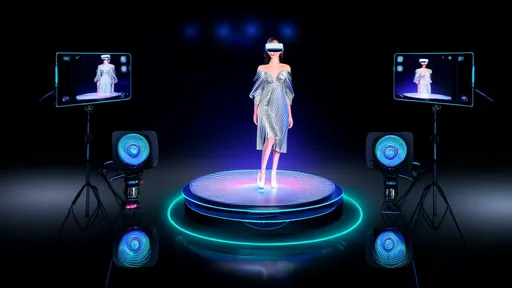
Gone are the days when live streams meant static shots or awkwardly edited jumps between angles. Today's cutting-edge productions deploy synchronized camera arrays that capture every nuance of a performance from multiple vantage points. When paired with VR headsets, these feeds transport viewers onto the stage itself, allowing them to pivot their gaze as if standing beside the performers. The emotional resonance is palpable—you feel the heat of spotlights, sense the spatial relationships between artists, and catch subtle interactions that flat video would miss entirely.
The technical ballet behind these experiences is nothing short of extraordinary. High-density camera rigs now employ AI-assisted calibration to maintain perfect frame alignment across dozens of lenses. Meanwhile, advanced spatial audio processing ensures that soundscapes shift realistically as users turn their virtual heads. Early adopters like music festivals and avant-garde theater companies report astonishing engagement metrics—viewers spend 300% longer immersed in VR streams compared to traditional broadcasts, with many voluntarily repositioning themselves multiple times during shows to experience different perspectives.
What makes this revolution particularly compelling is its democratizing potential. While mega-stars were first to experiment with multi-angle VR streams, the technology is rapidly trickling down to indie creators. Cloud-based production platforms now offer affordable tools for stitching together feeds from as few as three consumer-grade 360-degree cameras. This accessibility sparks innovation: imagine a underground band letting fans choose between the drummer's eye view or hovering above the lead singer's microphone during crucial high notes.
The psychological impact of this format warrants serious consideration. Cognitive researchers note that VR show attendees demonstrate stronger emotional recall and brand attachment compared to passive viewers. There's something primal about the ability to "move" within a performance space—it triggers the same neural pathways activated during actual physical attendance. Performers adapt accordingly, crafting shows with environmental storytelling elements that reward exploratory viewing rather than just front-facing spectacle.
Yet challenges persist. Bandwidth demands for streaming high-fidelity multi-perspective VR remain substantial, though 5G rollouts and new compression algorithms are easing bottlenecks. Some traditionalists argue that curation suffers when viewers control their sightlines—why would anyone look away from the soloist during a guitar break? But pioneers counter that freedom itself becomes the art form, comparing it to jazz improvisation where the audience's choices complete the composition.
As the technology matures, we're seeing fascinating hybrid formats emerge. Some streams now blend fixed cinematic angles with navigable VR spaces, allowing directors to guide attention during crucial moments while preserving interactivity elsewhere. Other experiments incorporate haptic feedback—imagine feeling vibration patterns align with bass frequencies as you "stand" near the stage subwoofers. The most ambitious productions are beginning to integrate light field technology, enabling parallax effects that make virtual stages feel truly volumetric.
The business implications are profound. Forward-thinking labels now treat multi-perspective VR captures as evergreen assets—a single properly shot performance can yield countless derivative experiences. Fans might pay premiums for exclusive camera access during live streams, or revisit archived shows from new angles years later. Merchandising becomes spatial too, with virtual merch tables placed strategically in the VR environment where users naturally "walk" between sets.
This revolution ultimately points toward a fundamental reshaping of performance itself. When audiences can choose their own sightlines, artists must conceive shows that work from infinite viewpoints. The very definition of "stage presence" expands to encompass spherical charisma—the ability to command attention not just from front-row seats, but from behind the amplifiers or up in the lighting grid. It's a thrilling creative challenge that's birthing entirely new genres of digital-native performance art.
As with any medium in its adolescence, the rules are being written in real time. But one truth already emerges clear: the passive viewer is becoming an active participant, and the fourth wall isn't just breaking—it's dissolving into a multidimensional space where every angle reveals fresh magic. The show isn't just going on; it's surrounding you, responding to you, and in the most profound sense, happening for you.
By /Aug 13, 2025

By /Aug 13, 2025

By /Aug 13, 2025
By /Aug 13, 2025

By /Aug 13, 2025
By /Aug 13, 2025

By /Aug 13, 2025
By /Aug 13, 2025
By /Aug 13, 2025
By /Aug 13, 2025
By /Aug 13, 2025
By /Aug 13, 2025
By /Aug 13, 2025

By /Aug 13, 2025

By /Aug 13, 2025

By /Aug 13, 2025

By /Aug 13, 2025
By /Aug 13, 2025
By /Aug 13, 2025
By /Aug 13, 2025
